Showing posts with label Australian Airlines. Show all posts

Saturday, November 25, 2017

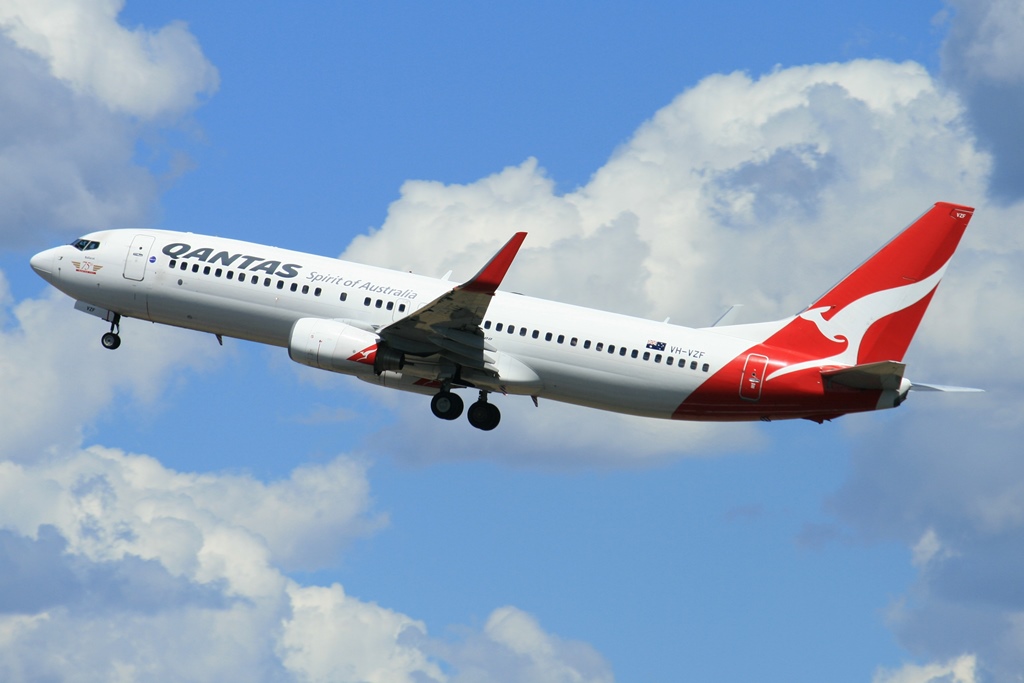
Recently Re-registered Qantas Airways Boeing B737-800 VH-VZF (ex ZK-ZQA) Pops into Hamilton Island Airport

A 'new' Qantas Airways aircraft has made its first visit to Hamilton Island Airport after recently being re-registered and re-entering service with the airline.

On Wednesday 22 November, Qantas Boeing B737-800 VH-VZF was noted operating into Hamilton Island Airport on the scheduled QFA866/867 service from and back to Sydney.


The B737-800 was originally ordered by Qantas back in 2009 and was registered VH-VZF in August of that year.  It was accepted by Qantas in early September 2009 and was the 162nd Boeing airliner delivered new to Qantas and the the 42nd Boeing B737 delivered new to Qantas.  VH-VZF also had a special '75th' logo and titles on the nose indicating that it was the 75th Boeing B737 to be delivered to the Australian Airlines / Qantas Airways group.

At that time too, VH-VZF also carried the New Zealand flag and 'ZQA' on the nosewheel doors.  Soon after its arrival into Melbourne, the aircraft entered the New Zealand aircraft register as ZK-ZQA during the middle part of September 2009 with Jetconnect Ltd in Auckland, New Zealand as the registered operator.  After then ferrying to Auckland Airport, ZK-ZQA was named 'Jean Batten' and then operated its first Qantas Jetconnect revenue service from Auckland to Brisbane as QFA116 on Thursday 17 September 2009.

ZK-ZQA operated its final service for Qantas Jetconnect this year on Wednesday 25 October when it arrived into Brisbane from Auckland as QFA124.  The aircraft was then cancelled from the New Zealand aircraft register and was then re-registered as VH-VZF, again with Qantas as the registered operator.  VH-VZF was also renamed 'Ballarat'.

After a test flight from and back to Brisbane, VH-VZF entered service with Qantas on Friday 10 November.  VH-VZF is pictured above at Adelaide Airport on Monday 20 November.

All photos taken by Tony Haynes  ©

Sunday, April 9, 2017

Happy 50th Birthday to the Boeing B737!

Fifty years ago today, on Sunday 9 April 1967, the first Boeing B737-130, N73700 (c/n 19437, l/n 1) made its maiden flight from Boeing Field in Seattle.

http://www.boeing.com/

The B737 series is the best-selling jet commercial airliner in history. The B737 has been continuously manufactured by Boeing since 1967 with 9,448 aircraft delivered and 4,506 orders yet to be fulfilled as of March 2017. Assembly of the 737 is performed at the Boeing Renton Factory in Renton, Washington, USA.

The first airline to operate the B737 was Lufthansa.

The B737-200 was a stretched version of the original, first ordered by United. In Australia, Ansett was the first operator of the Boeing B737-200 in Australia.

Ansett B737-200 VH-CZM at Melbourne in 1981  (Aero Icarus / https://www.flickr.com/)

In the years since, Ansett, along with Australian Airlines / Qantas Airways (incl Qantas Freight / Australian Air Express), National Jet Systems (now Cobham Aviation), Virgin Blue (now Virgin Australia), Alliance Airlines, Our Airline / Nauru Airlines (including on behalf of Norfolk Air), Toll Freight (incl Airwork New Zealand) and HeavyLift Cargo Airlines have all operated the 'classic' series of B737-300 and B737-400 aircraft, of which some 2000 were delivered, which also includes the shorter-bodied B737-500.

Ansett B737-300 VH-CZH at Adelaide Airport  (Tony Haynes / https://www.flickr.com/)

Ansett B737-300 VH-CZA at Adelaide Airport  (Tony Haynes / https://www.flickr.com/)

Australian Airlines B737-300 VH-TAX at Melbourne Airport  (Peter Lea / https://www.flickr.com/)  

Qantas B737-400 VH-TJF at Brisbane Airport in 2006

Australian Air Express B737-300SF VH-XMB at Cairns Airport in 2009

Qantas Freight B737-300SF VH-XML at Mackay Airport in 2016

National Jet System B737-300 VH-NJE at Adelaide  (Tony Haynes / https://www.flickr.com/)

Virgin Blue's first ever aircraft - B737-400 VH-VGA - at Brisbane Airport in 2001

Virgin Blue operated B737-300 VH-CZQ in the early 2000's

Our Airline B737-300 VH-INU landing at Rockhampton Airport in 2011

Nauru Airlines B737-300 VH-XNU at Gladstone Airport  (Photo taken by 'Mick'  ©)

It was also interesting to note that in the late 2000's, OzJet Airlines imported and operated four early-model Boeing B737-200s on their scheduled services on the East Coast and out of Perth (including on behalf of Norfolk Air).  Sadly OzJet ceased flying in 2012.

OzJet B737-200 VH-OZU at Brisbane Airport in 2006

Presently, Boeing produce the 'Next Generation' of B737 aircraft - currently offering B737-700 through to B737-900(ER) model aircraft - of which many examples of the B737-800 are operated by both Virgin Australia (incl Tigerair) and Qantas, while two B737-700s are still operated by Virgin Australia.  The B737-600 is no longer on the Boeing website.

Virgin Blue's first 'Next Generation' B737-700 VH-VBA at Brisbane Airport in 2006

Virgin Blue B737-700 VH-VBY in 100th B737 colours at Brisbane Airport in 2007

Virgin Australia B737-700 VH-VBY on approach to Mackay Airport

Virgin Blue B737-800 VH-VOA at Brisbane Airport in 2006

Virgin Blue B737-800 VH-VOA at Brisbane Airport in 2007 with winglets

Virgin Australia's latest B737-800 VH-YIY taxis at Brisbane Airport

Virgin Samoa B737-800 departs Townsville Airport

Tigerair B737-800 VH-VOR departs Townsville Airport  (Photo taken by Dave  ©)

Qantas B737-800 VH-VZM lands at Rockhampton Airport  (Photo taken by 'IAD'  ©)

Boeing B737 'Next Generation' aircraft also fly in Australia and through CQ in several military guises, predominantly by the Royal Australian Air Force (RAAF).

The RAAF operates a pair of Boeing Business Jet (BBJ) aircraft which are primarily a B737-700 commercial airframe with modifications to provide for private jet service. As operated by the RAAF's VIP 34 Squadron based at RAAF Base Fairbairn in Canberra, the 'BBJ1' is based on a B737-700 airframe, with elements from the B737-800.

RAAF BBJ A36-001 landing at Rockhampton Airport  (Photo taken by 'IAD'  ©)

Originally requested by the RAAF, the Boeing B737 AEW&C aircraft is a twin-engine airborne early warning and control aircraft and mounts a fixed, active electronically scanned array radar antenna instead of a rotating one (as seen on the B707-based Boeing E-3 Sentry).  The B737 AEW&C aircraft was designed for the RAAF under "Project Wedgetail" and designated as the E-7A Wedgetail.  The B737 AEW&C aircraft is roughly based on the B737-700ER.

RAAF E-7A Wedgetail A30-004 overshoots at Rockhampton Airport  (Photo taken by 'IAD'  ©)

The RAAF are also in the middle of taking delivery of 12 Boeing P-8A Poseidon Multimission Maritime Aircraft (MMA) aircraft as the preferred aircraft to replace the RAAF's fleet of Lockheed AP-3C Orion maritime surveillance aircraft.  The aircraft has been developed by Boeing Defense, Space & Security, modified from the B737-800ERX.

The RAAF's first P-8A Poseidon A47-001 on finals at Townsville Airport  (Photo taken by Leroy  ©)

Finally, as for the future of the Boeing B737, there are over 3700 orders in place for the 737MAX, with Southwest Airlines as the launch customer.

http://www.boeing.com/

Happy birthday to the all-time best-selling commercial aircraft!

Monday, February 24, 2014

The End of an Era as Qantas Airways Retires Final 'Classic' Boeing B737

A special post from CQ Plane Spotting as Qantas Airways operated its last 'classic' Boeing B737 passenger service on Sunday 23 February, with B737-400 aircraft VH-TJS and VH-TJX operating their final flights into Melbourne before retirement.

VH-TJX departs Brisbane Airport in 2006

VH-TJX 'Stawell' operated as QF815 from Canberra to Melbourne, while VH-TJS 'Jabiru' operated as QF819 from Canberra to Melbourne, marking the final flight for the 'classic' B737s of Qantas Airways / Australian Airlines.

VH-TJS at Brisbane Airport in 2006

The CFM56-powered B737 classic was introduced into Australia with Australian Airlines, which took delivery of the smaller B737-300 - VH-TAG - in August 1986.  Later that month Ansett too took delivery of its first B737-300 - VH-CZA. The first Australian Airlines B737-400 - VH-TJE - was delivered in December 1988.


Both the B737-300 and B737-400 became a mainstay of the Qantas domestic fleet following the Qantas-Australian Airlines merger in 1992-93. VH-TJS was in fact the last 737-400 to be delivered in Australian Airlines colours.  During the 1990s and early 2000s, Qantas B737-300s and B737-400s were a daily sight in Central Queensland, operating daily flights into Rockhampton, Mackay, Proserpine and Hamilton Island Airports.

VH-TJQ departs Rockhampton Airport in 2004

While Qantas now operates more than 60 'Next Generation' B737-800s, the 'classic' B737 continues to ply its trade in Australia for Qantas as a freighter, with four B737-300Fs remaining in service with Qantas Freight.  In addition, Nauru’s Our Airline has three B737-300s registered in Australia.  There are also B737-300 and B737-400 passenger and freight aircraft which also common sights at Australian airports, and occasionally Central Queensland Airports.

As shown below, the retired Qantas B737-400s have ended up stored at Victorville in the United States of America (USA).


Certainly a sad day.

Additional information sourced from Australian Aviation.

Saturday, June 1, 2013

CQ Plane Spotting Historic Spot - East West Airlines - Australia's Original 'Third' Airline


After our Historic look at the British Aerospace BAe 146 in service in Central Queensland, I had a couple of emails about East-West Airlines.  After a little research, this month's Historic Spot takes a look at Australia's original 'third' airline.

East-West Airlines was founded in Tamworth, New South Wales, in 1947 with the aim to "fight the city based airline monopolies".


Over several decades, East-West operated Lockheed Hudson and Douglas DC-3 aircraft, and eventually grew from an intrastate operator to Australia's third largest domestic carrier which, by 1982, owned and operated ten Fokker F-27 Friendship turbo-prop aircraft. By that time, East-west was also about to acquire its first jet aircraft - a Fokker F28 Fellowship.


East-West, already in an era still governed by the Two Airlines Policy, became the first "third" carrier operating between Sydney and Canberra.

In the following years, East-West competed vigorously with the ‘major’ airlines Ansett and Australian Airlines on inter-capital routes. The Australian aviation industry was highly regulated at the time under the Two Airlines Policy, which prevented East-West from flying directly between major capital cities, so they instead offered services between major cities via regional centres, including Central Queensland.


Routes included (amongst others) Sydney to Brisbane via Newcastle and Coolangatta, or Brisbane to Cairns via Mackay.

East-West primarily flew Fokker F-27 turboprop and F-28 jet aircraft but would eventually operate the larger BAe 146-300 and Boeing 737-300 aircraft for passenger operations.  They also flew Boeing 727-200s on some passenger and cargo flights.


In December 1983 East-West was sold to Perth-based Skywest Holdings Pty Ltd, a subsidiary of Griffin Holdings, which also owned Skywest Airlines.  Skywest Holdings belonged to a Western Australian coal mining entrepreneur.  Under the new ownership East-West was retained as an independent entity. Skywest Holdings announced in May 1985 to fully merge both Skywest Airlines and East-West, but this was not carried out bar some harmonisation of timetables.


Mid July 1987 East-West and Skywest were sold and then on sold to a company set up by Ansett's owners.  East-West continued to operate as a separate entity until 1993 when its operations were fully merged into Ansett.  On 1 January 1994, East-West Airlines formally ceased to exist.

My sincere thanks to Danny for allowing me access some fantastic old photos of these East-West aircraft shown above!

Monday, April 1, 2013

CQ Plane Spotting Historic Spot – British Aerospace (BAe) 146 / Avro RJ Aircraft at Central Queensland Airports

Qantas Airlink BAe 146-200 VH-NJU at Hamilton Island
  
The British Aerospace 146 (also BAe 146) is a regional airliner that was manufactured in the United Kingdom by British Aerospace, later part of BAE Systems. Production ran from 1983 until 2002.  Manufacture of an improved version known as the Avro RJ began in 1992. A further-improved version with new engines, the Avro RJX, was announced in 1997, but only two prototypes and one production aircraft were built before production ceased in 2001. With 387 aircraft produced, the BAe 146 / Avro RJ is the most successful British civil jet programme.

The BAe 146 / Avro RJ is a high-wing cantilever monoplane with a T-tail. It has four turbofan engines mounted on pylons underneath the wings, and has retractable tricycle landing gear. The aircraft has very quiet operation, and has been marketed under the name "Whisperjet". It sees wide usage at small city-based airports. In its primary role it serves as a regional jet, short-haul airliner or regional airliner.

The BAe 146 came in -100, -200 and -300 models. The equivalent Avro RJ versions are designated RJ70, RJ85, and RJ100. The freight-carrying version carries the designation "QT" (Quiet Trader), a convertible passenger-or-freight model is designated as "QC" (Quick Change). A "gravel kit" can be fitted to aircraft to enable operations from rough, unprepared airstrips.

In Australia, the BAe 146 / Arvo RJ has been / is operated by:  Ansett Airlines, Ansett Air Freight, Ansett W.A., Australian Air Express, Australian Airlink, Cobham Aviation, East-West Airlines, National Jet Systems, Norfolk Jet Express, Qantas Airlink, QantasLink, TNT, and Vincent Aviation.

The first BAe 146 to grace Australian skies was VH-JJP – a BAe 146-200A – c/n E2037. VH-JJP was initially operated by Ansett W.A. (West Australia) and predominately operated out of Perth.  Its first revenue service was Perth - Kalgoorlie - Perth as MV352/353 on 28 June 1985.

Ansett W.A. BAe 146-200A VH-JJP at Mangalore in 1986

Through the late 1980’s and into the early 1990’s Ansett W.A. operated seven BAe 146-200 aircraft – VH-JJP, VH-JJQ, VH-JJS, VH-JJT, VH-JJW, VH-JJX, and ZK-NZA (later VH-JJU).  These aircraft were transferred to the Ansett Australia mainline fleet when Ansett W. A. operations were merged with Ansett in July 1993, where they joined a pair of BAe 146-200QT freight aircraft – VH-JJY and VH-JJZ – which were flown for Ansett Air Freight (later Ansett Australia Cargo).

Ansett BAe 146-200A VH-JJP at Brisbane in 2000

Ansett Air Freight BAe 146-200QT VH-JJY at Brisbane in 1998

Re-branded Ansett Australia Cargo BAe 146-200QT VH-JJY at Brisbane in  2001

These little freighters were often noted of a night time passing through Rockhampton and Mackay Airports as they ferried cargo up and down the Queensland coast.

East West Airlines was regarded as Australia’s first “third” carrier, in an era dominated by the ‘big two’ Australian airlines – Ansett and Trans Australia Airlines (TAA) / Australian Airlines.  East-West primarily flew Fokker F-27 turboprop and F-28 jet aircraft but would eventually operate the larger BAe 146-300 and even Boeing 737-300 aircraft for passenger operations.  East-West competed vigorously with the major airlines on inter-capital routes. The Australian aviation industry was highly regulated at the time under the Two Airlines Policy, which prevented East-West from flying directly between major capital cities, so they instead offered services between major cities via regional centres, including Central Queensland. Routes included Sydney to Brisbane via Newcastle and Coolangatta, or Brisbane to Cairns via Mackay.

East West BAe 146-300 VH-EWJ (in Hamilton Island colours) at Melbourne in 1995

In mid-July 1987, East-West was eventually sold to a company set up by Ansett's owners.  East West continued to operate as a separate entity until June 1993 when its operations were fully merged into Ansett.  Most of its fleet of BAe 146-300 aircraft – VH-EWI, VH-EWJ, VH-EWL, VH-EWM, VH-EWR, and VH-EWS – were transferred to Ansett Australia who would go on to use these aircraft to fly mostly regional sectors from Brisbane to Rockhampton, Mackay, Proserpine / Whitsunday Coast, and Hamilton Island. 

Ansett BAe 146-300 VH-EWS at Brisbane in 1999

In the early 1990’s Australian Airlines (now Qantas Airways) and National Jet Systems (now Cobham Aviation) formed regional subsidiary airlines for operations in regional Western Australia and on East coast.  Airlink (operated by National Jet for Australian Airlines) and Southern Australia Airlines (operated by Australian Airlines) were both were operators of the BAe 146.  National Jet commenced BAe 146 operation for Australian Airlink on 2 August 1991 with BAe 146-100 VH-NJC operating the first Australian Airlink revenue service from Brisbane to Mackay as TN218.

Australian Airlink BAe 146-100 VH-NJR at Proserpine /  Whitsunday Coast in 1992

Over the subsequent years, Airlink branded BAe 146 aircraft were also seen at all major Central Queensland coastal airport – Rockhampton, Mackay, Proserpine / Whitsunday Coast, and Hamilton Island.

Up until the early 2000’s some 21 BAe 146 aircraft – 100, 200, and 300 types – were operated by National Jet for Australian and later Qantas Airlink.  Two of these aircraft – BAe 146-200s VH-YAE and VH-YAF were also transferred to the Southern Australia fleet for operations throughout New South Wales, Victoria, and Tasmania.  Also during this time, National Jet operated BAe 146 aircraft on lease to Norfolk Jet Express (VH-NJD and VH-NJY) – for services between the Australian East Coast and Norfolk Island - and Air Niugini (VH-NJW).

Qantas Airlink BAe 146-200 VH-NJG at Brisbane in 1997

Qantas Southern Australia Airlines BAe 146-200 VH-YAE at Sydney in 2000

Norfolk Jet Express BAe 146-100 VH-NJD at Brisbane in 1997

Air Niugini BAe 146-100 VH-NJW at Brisbane

In 2001, Southern Australia Airlines, Airlink, as well as Sunstate Airlines, Eastern Australia Airlines and Impulse Airlines were all rebranded as QantasLink, though each entity retained a certain amount of independence.

QantasLink BAe 146-200 VH-NJQ at Rockhampton in 2002

QantasLink BAe 146-200 VH-NJJ at Brisbane in 2003

All the QantasLink BAe 146 aircraft were subsequently transferred to National Jet Systems, but continued to operate under the QantasLink banner.  Slowly, as National Jet acquired larger Boeing B717-200 aircraft for operations for QantasLink, by the mid 2000’s the BAe 146 aircraft were transferred to National Jet’s Western Australia charter operations.

Cobham BAe 146-300 VH-NJP at Perth in 2011

In March 2009, National Jet Systems was renamed to Cobham Aviation and these hard working BAe 146 / Avro RJ aircraft still fly throughout Western Australia and South Australia on Cobham’s extensive FIFO charter network.

Cobham BAe 146-100 VH-NJC at Perth in 2011

Cobham BAe 146-300 VH-NJQ at Perth in 2011

National Jet Systems / Cobham Aviation also operates four dedicated BAe freight aircraft for Australian Air Express – Bae 146-100QT VH-NJV and BAe 146-300QT’s VH-NJF, VH-NJM and VH-NJZ.

Australian Air Express BAe 146-300QT VH-NJM at Brisbane in  2000

Australian Air Express BAe 146-100QT VH-NJV at Brisbane in 2009

Cobham BAe 146-300QT VH-NJZ at Adelaide in 2012

There has been talk in that Australian Air Express will soon utilise a BAe 146 freighter on its nightly cargo run from Mackay - Rockhampton - Brisbane however this is yet to eventuate.